FAQs!
Definitely, SRON surpasses Python in terms of speed in several cases.
SRON is very simple and easy to understand. So, you don't need video tutorials to learn. Just read the official documentations carefully from https://sron.gitbook.io/docs .
The design and implementation of SRON is made with the purpose of platform independency. Till Version 2.2, SRON is only available for Windows but with the release of SRON version 2.3, it is also available for Windows and Linux system with x64 architecture.
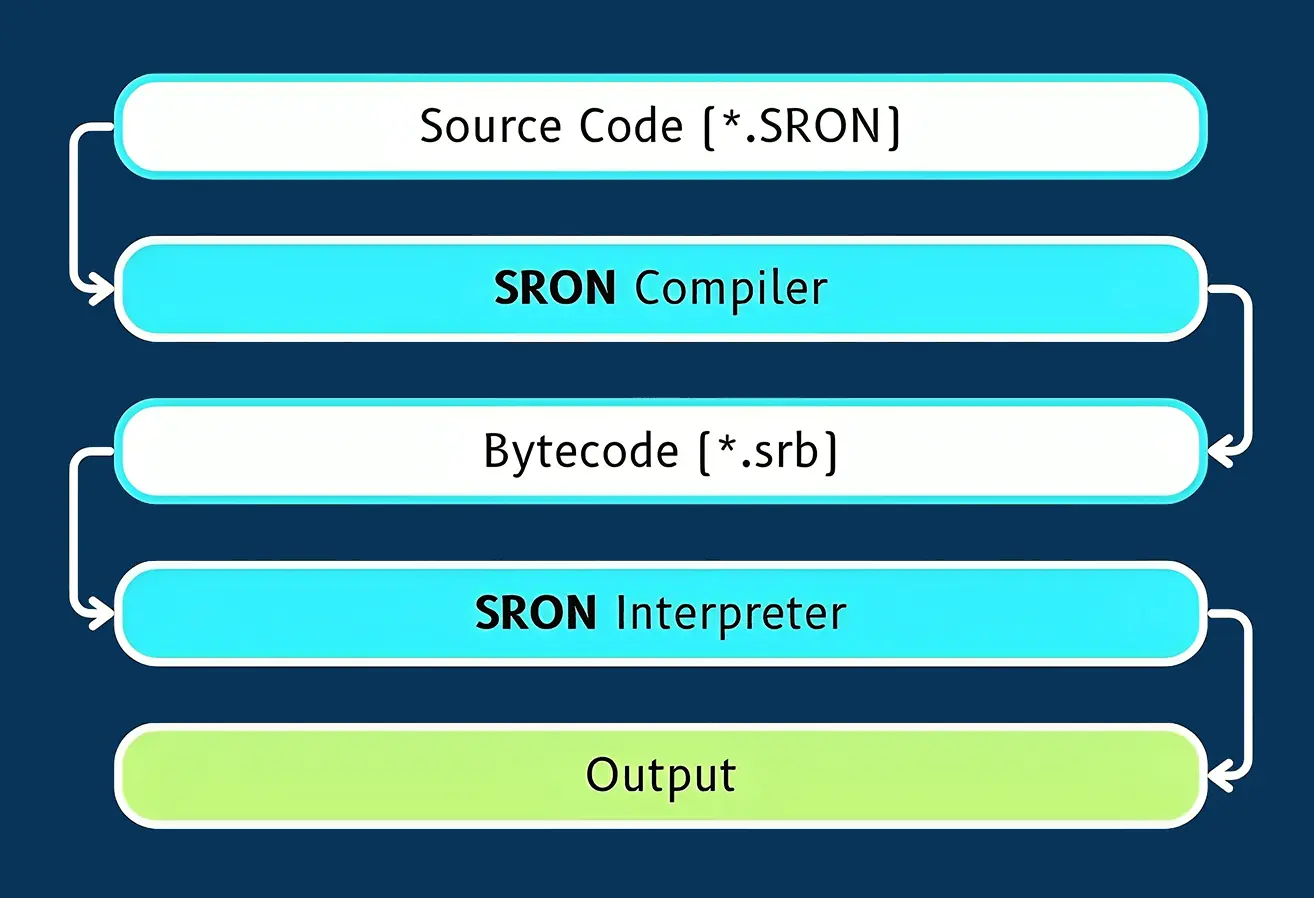
The Latest version of SRON is version 2.3 which provides insane features like garbage collector, hashed binary bytecode, static + dynamic typing, for-each loop, return value optimization, multi-platform bytecode, CLI designing keywords, File reading+writing, 90+ in-built functions and a lot more.
SRON is developed by Saksham Joshi as his bachelor's final year project.
Till SRON Version 2.3, SRON doesn't support classes. It is a functional programming language.
Saksham solely created SRON programming language without any mentorship or guidance.
The first publicly available version of SRON was v1.3 (launched on May 2024) and then v1.4, v1.5, v2.1, v2.2 and current latest version is v2.3.
SRON was developed as a project to push past Saksham's limits, but eventually it became a source of self-satisfaction and self-fulfillment, as well as a passion project.
SRON's name was inspired by JSON, where ON stands for Object Notation (same as JSON), S stands for Saksham, and R stands for Rapid, which was used because from the start, the goal of SRON was to be a fast and rapidly executing programming language.